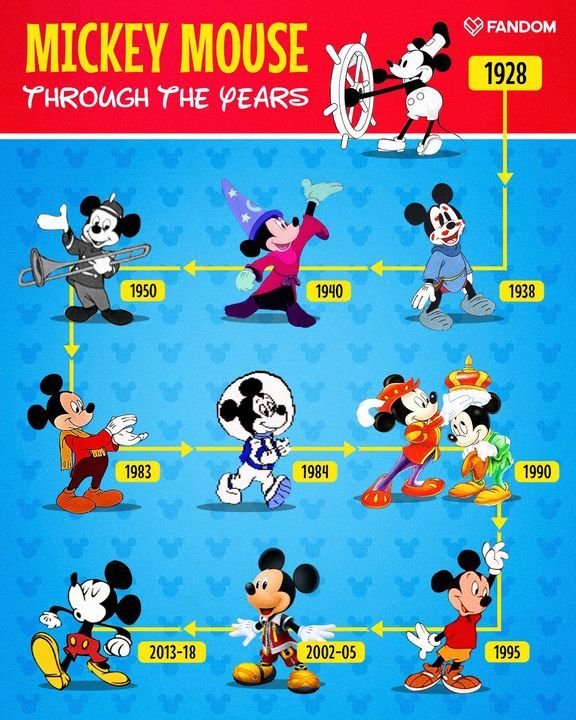
For nearly a century, Mickey Mouse has been more than just a cartoon character; he's a global icon, a symbol of hope, happiness, and the magic of storytelling. His ears, known the world over, have graced everything from movie screens to merchandise, but the Mickey we know today isn't the exact same mouse who first whistled his way onto the screen in 1928. Indeed, tracing Mickey Mouse's evolution through the decades reveals a fascinating journey of design innovation, cultural adaptation, and artistic refinement that mirrors the very history of animation itself.
This isn't just about a mouse changing his clothes; it's about how Walt Disney's beloved creation has continuously adapted, reflecting technological advancements, shifting audience tastes, and the enduring power of a meticulously crafted persona. Whether you're a lifelong Disney fan, an animation historian, or simply curious about the longevity of a true legend, understanding Mickey's visual journey offers a unique window into why he remains so universally adored.
At a Glance: Mickey's Milestones in Mouse Design
- 1920s Debut: Started as a mischievous, rubber-hose animated, black-and-white character with large eyes, a button nose, and a thick tail. Gained gloves and shoes quickly.
- 1930s Refinement: Became a symbol of hope during the Great Depression. Design matured with a shorter nose, "pie-eyes," then crucial pupils, and a flesh-toned face, introduced color.
- 1940s Heroics: Took on more complex roles like Sorcerer's Apprentice in "Fantasia," gaining expressive eyebrows and detailed features. His ears learned to "turn" with perspective.
- 1950s Television Star: Conquered the small screen and became the host of Disneyland, adopting cleaner lines, rounder eyes, and a consistently friendly look.
- 1960s-1970s Enduring Icon: Transitioned to a dependable mascot after Walt Disney's passing, maintaining a consistent, lovable design, with some minor tweaks for TV revivals.
- 1980s Renaissance: Reintroduced to new generations with animated specials, featuring a more expressive, smoother, and richly colored design.
- 1990s Multimedia Powerhouse: Cleaned up and consistent thanks to computer-assisted animation, starring in various series and direct-to-video films.
- 2000s Blending Classic & New: Saw his first CGI appearances while balancing modern enhancements with his classic appeal, often seen as a charming host.
- 2010s Artistic Reimagining: Embraced a bold, angular, and exaggerated style in new shorts, paying homage to his mischievous roots while exploring new animated frontiers.
- 2020s & Beyond: Timeless Adaptability: Continues to evolve across various media, from energetic 2D animation to immersive 3D attractions, proving his design remains infinitely adaptable.
The Birth of a Star: Mickey in the Roaring Twenties (1928-1929)
Imagine a world without Mickey Mouse. It's almost impossible today, but in 1928, a new star was born from the creative minds of Walt Disney and Ub Iwerks. This wasn't just another character; it was a gamble, a response to a stolen rabbit, and the start of a legend. When Mickey debuted in "Steamboat Willie," he burst onto the scene with a boisterous energy that instantly captivated audiences. Crucially, "Steamboat Willie" wasn't just a cartoon; it was the first synchronized sound cartoon, transforming the viewing experience and making Mickey an instant innovator.
Early Mickey was a far cry from the polished icon we recognize today. He was a mischievous, black-and-white figure, a product of what animators called "rubber-hose animation." This style gave him incredibly stretchy limbs and bouncy, fluid movements, allowing for exaggerated expressions and physical comedy. His core features included a prominent button nose, large oval eyes, and a perpetually infectious laugh. Looking back at his very first appearance in "Plane Crazy" (which actually premiered before "Steamboat Willie" but lacked sound), you'd notice a few key differences: no gloves, no shoes, and eyes so large they took up nearly half his face, all anchored by a notably thick tail.
The evolution was swift. By his second short, "The Gallopin' Gaucho," Mickey gained a pair of shoes, a subtle but important detail that added to his character's "completeness." His eye design also saw a tweak, with pupils appearing as small black ovals, giving him a more focused gaze. "Steamboat Willie," the short that truly launched his stardom, further refined his look with closer-spaced buttons on his shorts. The year 1929 brought another iconic addition: white gloves in "The Opry House." This wasn't just a fashion statement; in black-and-white animation, white gloves made his hands stand out against his dark body, improving clarity and expression. By the time "The Karnival Kid" rolled around later that year, Mickey had gained his famous "pie-eyes" (a wedge cut out of the pupil) and even a pair of subtle eyebrows, a look that would define him for the next decade.
From Depression-Era Hero to Technicolor Dream: Mickey in the 1930s
The 1930s were a turbulent time for the world, marred by the Great Depression, but for Mickey Mouse, they were a period of immense growth and transformation. As despair gripped the nation, Mickey became a cherished symbol of hope, his cheerful antics offering a much-needed escape. His design during this decade underwent significant refinement, solidifying many of the characteristics we still associate with him.
His face became a bit more compact, with a shorter, less elongated nose. The white gloves, introduced earlier, became a permanent fixture, enhancing his expressiveness. His ears and body, while still somewhat flexible, gained more definition, moving away from the extreme rubber-hose fluidity towards a more solid, recognizable form. Interestingly, "Blue Rhythm" (1931) briefly experimented with removing his pie-eyes and eyebrows, a fleeting departure from his established look.
The true game-changer arrived with color. Mickey first appeared in vibrant hues in "Parade of the Award Nominees" (1932), showcasing green shorts, a precursor to his signature red. It wasn't until "Mickey's Garden" (1935) that he truly embraced full-color animation with his standard outfit: red shorts, now with oval-shaped buttons, and, for this specific short, yellow gloves. Later that same year, "Pluto's Judgement Day" introduced a pear-shaped, more flexible body, allowing for even more dynamic movement, though his gloves returned to white in "Mickey's Grand Opera" (1936), where they mostly remained.
A pivotal shift in Mickey's facial design came with a flesh-toned hue, first seen in "The Whalers" (1938). But the most monumental change was spearheaded by animator Fred Moore, with cartoonist Floyd Gottfredson implementing it in the comics by 1938, and it reached animation in "Mickey's Surprise Party" (1939). This redesign gave Mickey eyes with distinct, separated pupils, replacing the pie-eyes. His face also became a more vibrant flesh tone, making him feel more three-dimensional and allowing for a broader range of nuanced emotions. This late 30s look marked a profound step towards the Mickey we'd see in his most ambitious role yet.
The Sorcerer, the Patriot, and the Evolving Form: Mickey in the 1940s
As the world plunged into World War II, Mickey Mouse rose to the occasion, starring in patriotic shorts that boosted morale. But his most iconic role of the decade, and perhaps of his career, arrived at the very beginning: "Fantasia" (1940). As the Sorcerer's Apprentice, Mickey transcended typical cartoon antics, taking on a visually ambitious and dramatic persona. This grand cinematic outing demanded a bolder, more detailed design. Here, Mickey sported expressive eyebrows (a return after being absent for a while) and more refined features, allowing for a broader range of dramatic expressions suited to the film's classical music backdrop.
Beyond the magical caper, Mickey's everyday design continued its subtle evolution. In "Mr. Mouse Takes a Trip" (1940), his shoes transitioned from their usual black to a brown shade, a minor detail, but one that added to his visual texture. "The Little Whirlwind" (1941) saw him with a slimmer body, a more streamlined silhouette, and a critical anatomical update: "perspective ears." Prior to this, Mickey's ears were famously always depicted as flat, perfect circles, regardless of which way his head turned. Now, they could rotate and be shown in perspective, adding a new layer of realism and depth to his animation. Some shorts even showed the insides of his ears as black.
These changes reflected a growing sophistication in Disney animation, moving away from the flat, two-dimensional look of the early days. By "Mickey's Delayed Date" (1947), his design was largely consistent: he appeared taller, with a more mature build, and his rounded ears consistently faced the camera, showcasing the perfected perspective ear technique. This streamlined, slightly more mature Mickey was ready for a new era.
The Television Host and Park Icon: Mickey in the 1950s
The 1950s were a pivotal decade for Disney, marking the studio's foray into television and the grand opening of Disneyland. Mickey Mouse, ever the star, was front and center for both. He conquered the small screen as the beloved host of "The Mickey Mouse Club" (1955), a show that introduced him to an entirely new generation of children and cemented his status as a wholesome, friendly leader. That same year, he became the official host of Disneyland, greeting guests and embodying the magic of the newly opened theme park.
His appearance during this period solidified into a cleaner, more approachable design. His lines were sharper, his eyes rounder, and his overall demeanor exuded warmth and friendliness. While his core features remained, the emphasis was on clarity and consistency for mass reproduction across television, merchandise, and park appearances. Interestingly, "Pluto's Party" (1952) briefly showed him with a more angular, shorter design and a return of his eyebrows, demonstrating that even in this era of consolidation, experimentation wasn't entirely off the table.
However, his most widely recognized 50s look, particularly in "The Mickey Mouse Club" and associated commercials (like for Nash Rambler in 1955), often featured simpler, angular heads and ears. While eyebrows might pop up in intros, the prevalent design embraced his classic, pupil-eyed look, streamlined for the new age of media. This iteration of Mickey, approachable and universally recognizable, became the standard bearer for the Disney brand as it expanded exponentially. For nearly a century, how old is Mickey Mouse? has been a question tied not just to his debut, but to his incredible adaptability through time.
The Enduring Mascot: Mickey in the 1960s & 1970s
Following Walt Disney's passing in 1966, the animation output featuring Mickey Mouse entered a somewhat quieter period. While the studio continued to thrive, Mickey's role shifted from active protagonist in new shorts to that of a symbolic leader and the dependable mascot of the Walt Disney Company. His animation appearances became less frequent, but his presence was felt everywhere else – in the theme parks, on merchandise, and as the smiling face of the company.
During these two decades, Mickey's design largely maintained the consistent, friendly, and lovable look established in the 1950s. The focus was on reinforcing his established identity rather than reinventing it. He was the familiar, comforting figure that audiences had come to trust. When "The Mickey Mouse Club" saw a revival in 1977, Mickey's design for the show featured a slightly altered look, similar to his 1953 appearance but with thinner eyebrows, somewhat smaller eyes, and a different outfit for the club's new generation of Mouseketeers. This period showcased Mickey's incredible staying power, proving that even with less new animated content, his iconic status remained unshakeable. He was, quite simply, the heart of Disney.
A Renaissance and Global Icon: Mickey in the 1980s
The 1980s heralded an animation renaissance for Disney, and Mickey Mouse was central to this resurgence. The decade brought him back into the animated spotlight with "Mickey's Christmas Carol" (1983), a heartwarming and critically acclaimed special that reintroduced him to new generations. In this featurette, Mickey starred as Bob Cratchit, showcasing his ability to embody emotional depth and a more complex character.
His look for this special was subtly updated, featuring a design that was more expressive, with smoother movements and richer, more nuanced color tones. A notable design choice here was the removal of his eyebrows, a nod back to his classic 1940s style, giving him a simpler, more innocent facial expression. His shoes, which had seen various color changes over the decades, were depicted as a lighter brown.
By the end of the decade, Mickey's enduring appeal was highlighted with his memorable cameo in "Who Framed Roger Rabbit" (1988), where he appeared in his current, widely recognized design, sometimes featuring yellow buttons on his shorts. This appearance, alongside other iconic cartoon characters, cemented his place in animation history. His 60th birthday in 1988 was a global celebration, affirming his timeless charm and continued relevance. The 80s proved that Mickey wasn't just a relic of the past; he was a dynamic, evolving character ready for the future.
The Multimedia Superstar: Mickey in the 1990s
The 1990s truly established Mickey Mouse as a multimedia superstar, expanding his reach across various television series and direct-to-video specials. This decade marked a period of consistency and polish for his design, greatly aided by advances in computer-assisted animation. Shows like "Mickey Mouse Works" (1999-2000) and "House of Mouse" (2001-2003, though starting in the late 90s) put Mickey back in regular animated rotation, allowing for a unified and clean visual presentation.
A significant change during this time was the passing of his longtime voice actor, Wayne Allwine, who took over the role in 1977. His voice, alongside his refined look, became synonymous with Mickey for a new generation. Visually, Mickey's design became cleaner and more consistent across different productions, leveraging technology to ensure uniformity.
However, even with consistency, there were subtle variations. In "The Muppets at Walt Disney World" (1990), he was seen with eyebrows again, demonstrating that context often dictated specific design choices. "A Goofy Movie" (1995) featured him with eyebrows, a red shirt, orange pants, and brown shoes, offering a more contemporary, casual look. "Runaway Brain" (1995), a more experimental short, depicted him as shorter with notably larger yellow buttons on his shorts (and two back buttons removed), a departure from his standard attire. "Mickey Mouse Works" (1999-2000) then brought back the classic white, larger buttons, showing a return to a more traditional aesthetic while benefiting from modern animation techniques. These varied appearances showcased his versatility while his core design remained recognizable.
Balancing Innovation and Nostalgia: Mickey in the 2000s
The new millennium saw Mickey Mouse navigating a delicate balance between embracing technological innovation and honoring his rich legacy. The 2000s were a time when Disney experimented with new animation styles while ensuring Mickey's classic charm remained intact.
"House of Mouse" (2001-2003) presented Mickey as a charming, tuxedo-clad host, a role that perfectly suited his established persona as the face of the Disney brand. His design here was classic, clean, and welcoming. Even in this period, the presence of eyebrows remained a flexible element, with "Mickey, Donald, Goofy: The Three Musketeers" (2004) depicting him with them in certain scenes, depending on the stylistic needs of the production.
A landmark moment for Mickey's visual evolution occurred with "Mickey's Twice Upon a Christmas" (2004), which showcased his very first CGI appearance. This transition to three-dimensional animation brought new visual possibilities. In this CGI iteration, Mickey's ears once again demonstrated perspective (reminiscent of his 1941-42 shorts), and his eyes appeared smaller with larger black pupils, giving him a slightly more contemporary, less "flat" look. While his design remained fundamentally classic, it was enhanced for modern screens, allowing for new levels of depth and movement that 2D animation couldn't always achieve. This decade solidified Mickey's ability to transcend animation mediums while maintaining his iconic status.
Reimagining an Icon: Mickey in the 2010s
The 2010s brought a bold and exciting new chapter to Mickey Mouse's visual journey, epitomized by the critically acclaimed 2013 Mickey Mouse cartoon series. This series marked a significant stylistic departure, embracing an angular, exaggerated design that consciously paid homage to his mischievous, rubber-hose animated roots of the 1920s. Created by Paul Rudish, this iteration featured his 1929 "pie-eyes," a distinctly skinnier body, a white-tinted face (a throwback to early black-and-white cartoons), and vibrant yellow buttons on his shorts. It was a fresh, energetic take that proved Mickey could be both classic and contemporary.
Beyond this breakout series, Mickey's design explored other avenues. "Epic Mickey" (2010), a video game, offered a different kind of nostalgia, returning him to his 1936 design – but rendered in stunning 3D and full color. This allowed players to experience a more classic Mickey in a modern interactive environment. "Mickey Mouse Clubhouse" (2006-2016), a popular Disney Junior series aimed at preschoolers, presented a simpler, friendlier CGI design with flat/round ears and buttons, and eyes that resembled his early 1940s cartoons, though with realistic button textures.
The animated short "Get a Horse!" (2013) provided another unique blend, starting with a design directly based on "Steamboat Willie" before breaking into modern 3D. "Mickey Mouse Mixed-Up Adventures" (2017-2021) continued the Clubhouse design with slight variations for its new format. Towards the end of the decade and into the next, new Disney Junior series introduced a 2D flash animation design featuring extremely large eyes and pupils, 1950s-style eyebrows, and even dark blue fur, showcasing a willingness to push visual boundaries for different audiences and platforms. The 2010s demonstrated that Mickey's design could be reinvented while still capturing his essential spirit.
The Timeless Icon: Mickey in the 2020s and Beyond
As Mickey Mouse hurtles towards his centennial, the 2020s continue to showcase his remarkable adaptability and enduring appeal. He's not just a character from the past; he's an active, evolving presence across all forms of media, proving that true icons are never truly "finished."
The acclaimed "The Wonderful World of Mickey Mouse" series picks up where the 2013 shorts left off, continuing that energetic, angular style that celebrates his mischievous roots while telling contemporary stories. In the theme parks, attractions like Mickey & Minnie’s Runaway Railway seamlessly blend traditional 2D animation aesthetics with immersive 3D physical spaces, creating a hybrid experience that honors his history while pushing boundaries.
Recent iterations highlight his incredible versatility. You can find his classic 1950s design making an appearance in "Chip 'n' Dale: Park Life" (2021-2024), demonstrating the timelessness of certain looks. "Mickey Saves Christmas" (2022) offered a charming stop-motion design, adding another unique texture to his portfolio. For Disney's centennial celebration, "Once Upon a Studio" (2023) featured his iconic "Mickey's Birthday Party" design, a beloved 1930s look. And even in a short from 2024, Mickey can be seen sporting modern clothing, proving he can adapt to any era without losing his core identity. Looking ahead, "Mickey Mouse Clubhouse+" (2025) promises to feature his CGI design with even more realistic textures, further blurring the lines between animation and reality.
Mickey Mouse remains a global phenomenon, constantly bridging generations. His evolution isn't just a series of design changes; it's a testament to the enduring power of creative vision, technological innovation, and a fundamental understanding of what makes a character truly connect with people. He is, and will always be, the heart of Disney, a timeless icon continuing to bring joy and wonder to the world.
Understanding Mickey's Adaptability: More Than Just a Pretty Face
Why does Mickey Mouse's design shift so often, yet always remain recognizable? It's a question that goes to the core of character design and brand longevity. His evolution isn't arbitrary; it's a calculated dance between artistic vision, technological progress, and cultural relevance.
The "Mickey Mouse Problem"
For any character as iconic as Mickey, there's a delicate balance to strike: how do you keep him relevant and fresh for new generations without alienating the legions of fans who adore his classic look? This is often referred to as the "Mickey Mouse Problem" in animation circles. The solution, as Disney has expertly demonstrated, isn't to pick one definitive look, but to embrace a flexible canon of designs.
- Technological Drivers: Early changes were driven by the limitations of black-and-white animation (white gloves for visibility) and the advent of sound. Later, color, the shift from cel animation to xerography, and then to full CGI, each opened new doors for visual fidelity and expressiveness.
- Artistic Interpretations: Visionary animators like Fred Moore pushed for more dimension and personality, moving beyond the "rubber hose" era. Modern directors like Paul Rudish have reinterpreted his past in dynamic new ways.
- Audience & Medium Adaptations: A mischievous, angular Mickey might be perfect for a fast-paced short series, while a softer, rounder CGI Mickey suits a preschool educational show. A streamlined 1950s design works best for a theme park mascot. Each medium and target audience demands a slightly different approach to maximize connection.
- Cultural Context: From a symbol of hope during the Great Depression to a patriotic figure in WWII, Mickey's emotional resonance often dictated subtle tweaks to his demeanor and expressions.
The Power of Core Elements
Despite myriad changes, certain elements of Mickey's design are sacrosanct: his round ears (even when in perspective), his button nose, his expressive white gloves, and his red shorts. These are his visual DNA, the anchors that ensure whether he's pie-eyed or pupil-eyed, CGI or hand-drawn, he is unmistakably Mickey. His adaptability comes from the ability to iterate on the periphery while preserving these immutable core features.
Your Burning Questions About Mickey's Look, Answered
Mickey's long history naturally raises a few questions about his visual journey. Here are some of the most common:
Why Did Mickey Get Gloves?
Mickey Mouse famously received his white gloves in "The Opry House" (1929). The primary reason was practical: in the early days of black-and-white animation, Mickey's black body meant his hands could easily get lost against his own silhouette or dark backgrounds. White gloves provided necessary contrast, making his hand gestures clearer and more expressive. They also added a touch of humanity and cuteness, making him seem more like a friendly performer.
When Did Mickey Mouse First Appear in Color?
Mickey first appeared in color in "Parade of the Award Nominees" (1932), a short, promotional film, where he sported green shorts. His first full-color short, however, was "The Band Concert" (1935), though he appeared in his standard red shorts and outfit in "Mickey's Garden" that same year.
What's With the "Perspective Ears"?
In his earliest designs, Mickey's ears were always drawn as perfect, flat circles, regardless of which way his head was facing. This gave him a somewhat abstract, iconic look. In "The Little Whirlwind" (1941), animators began drawing his ears in perspective, meaning they would turn and foreshorten with his head movements, just like real ears. This added a new level of realism and three-dimensionality to his animation, a significant step forward from his earlier, flatter appearance. While some modern iterations revisit the flat-ear look for stylistic reasons, the perspective ears became a standard for much of his classic era.
Has Mickey Mouse Ever Worn More Than Just Red Shorts?
Yes! While red shorts are his signature attire, Mickey has appeared in various outfits throughout his career. Early on, he had green shorts in his first color appearance. As the Sorcerer's Apprentice in "Fantasia," he wore a specific red robe and conical blue hat. He's been seen in suits, tuxedos, adventurous gear, and even modern street clothes in some recent shorts, demonstrating his versatility. However, his default and most recognized look remains the red shorts with yellow or white buttons.
The Enduring Magic: What Mickey's Evolution Teaches Us
Mickey Mouse's journey through the decades is more than a simple chronicle of design changes; it's a masterclass in adaptation, brand management, and the power of animation. From a mischievous, rubber-hose pioneer to a sophisticated, global icon, Mickey has consistently redefined himself while staying true to the optimistic spirit Walt Disney infused into him.
His evolution shows that even the most established characters can, and must, change with the times. It highlights the intricate relationship between art and technology, where each advancement unlocks new possibilities for expression. Ultimately, Mickey's ability to remain relevant for nearly a century isn't just about his changing looks, but about the timeless qualities he embodies: joy, perseverance, and a touch of mischief. He teaches us that true icons aren't static; they are living, breathing embodiments of imagination, constantly evolving, perpetually enchanting, and always ready for their next adventure.